Toni Morrison Society Places Sixth Bench at Lisner Auditorium in Washington, DC
On Wednesday, September 21st, the Toni Morrison Society placed its sixth Bench by the Road in front of the Lisner Auditorium on the campus of the George Washington University in Washington, D. C. The Bench, donated by Scott and Evelyn Schreiber, was placed in recognition of the end of racial discrimination at the auditorium, which denied the admissions of African Americans in its audience. Toni Morrison; Steven Knapp, President of George Washington University; Vincent Gray, Mayor of Washington D.C.; and Kwame Brown, Chair of the D.C. City Council; Carolyn Denard, Board Chair of the Toni Morrison Society; and Scott and Evelyn Schreiber were among those who spoke during the ceremony. Members of the Toni Morrison Society assisted with the unveiling of the bench, and the Voice Gospel Choir of George Washington University sang a medley of spirituals and freedom songs to close the program.
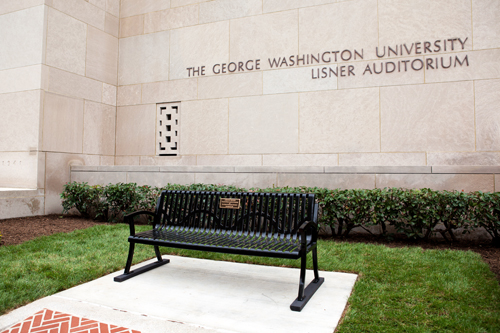
The integration of Lisner Theater was a significant moment in American history. On October 9, 1946, the theater refused to admit a group of African-Americans, including the Dean of the Medical School at Howard University. The managers claimed that they were following long held "community policy" in denying admission. The local chapter of the American Veterans Committee wrote a letter of protest to the George Washington University President Cloyd Heck Marvin. The controversy grew into a city-wide public debate and around Lisner Theater's policy of racial segregation.
On October 29, 1946, the opening night of the play Joan of Lorraine as the first commercial theater production in Lisner Auditorium, the building was surrounded by protesters and picket lines. The protests were inspired by lead actress Ingrid Bergman, who was outraged by the theater's policy of racial discrimination. In response to continuing protests by the American Veterans Committee and others, the George Washington University Board of Trustees, decided, in an action in 1947, that the university would no longer impose restrictions on attendance at the auditorium.
The racial integration of Lisner Auditorium was an important victory in the struggle for racial justice in public accommodations for African Americans in the nation's capital and was an important precursor to the Civil Rights Movement of the 1960s that would insist on racial justice throughout the nation.